


This International Women’s Day (8 March) we are proud to celebrate the brilliant female pupils at Chambers.
Each of them has written a short piece reflecting on what it means to be a woman in the legal profession and the journey that brought them to the Bar. Their articles share honest insights into the challenges they’ve faced, the support that has helped them along the way, and the ambitions they carry into the next stage of their careers.
We are incredibly proud to have them as part of Chambers and to highlight their voices today. Their reflections are a powerful reminder of the talent, resilience and perspective women continue to bring to the legal profession.
Take a moment to read their articles and join us in celebrating the next generation of women at the Bar as they embark on their first day in practice on 7th April 2026.
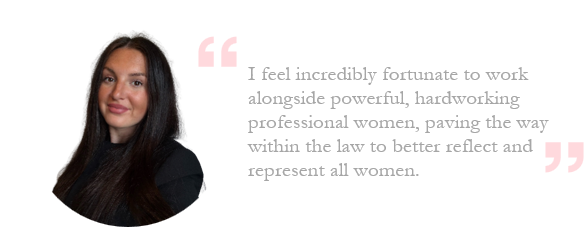
The family bar is not short of formidable female role models. They once inspired me to strive towards a career at the independent bar and now inspire me to achieve big things in this position of responsibility. In light of this year’s theme for International Women’s Day of “Rights, Justice and Action” it is important to reflect on the privilege that comes with practicing in family law. The law becomes both a voice and a tool for women navigating separation, protecting their children, rebuilding after trauma, or finding the courage to assert rights they did not know they had.
For me in getting to this stage, at the youngest age I can be is representative of the opportunities and social shift within the profession. It is important to recognise the changes to the independent Bar that allow me to enter this vocation at a time where flexible working and small cultural shifts have existed for some time. There remains a way to go, I will still have to learn to advocate for myself as well as I do for my clients. I think this takes a lot of courage when you're younger, a woman and just starting out.
The advice I have continued to receive is to stop apologising and stand in good confidence, which rarely involves being the loudest in the room. Women can be and should be the natural choice at the front of the court room and at the head of the table. I hope by the time I reach my next milestone there are as many women at all levels of the judiciary as there should be.
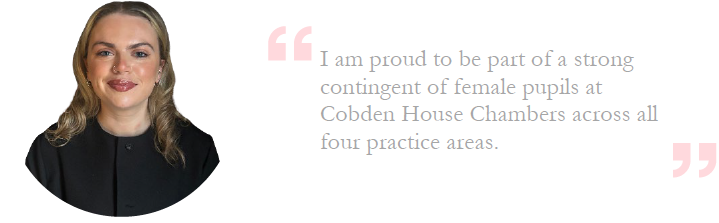
A people-focused career in law was something I knew I wanted for a long time, but I was unsure what specifically what that would look like. The Bar initially felt intimidating and out of reach. Despite enjoying public speaking, and wanting a rewarding and challenging career, stereotypes about the profession discouraged me. It was only through mini-pupillages that I realised how much more diverse the Bar is than it was 30 years ago.
Experiences such as hospitality work, volunteer work whilst at university, and studying the Bar part-time whilst working full-time, all helped me hone skills in time-management, empathy, and communicating clearly. This has equipped me well for the varied and often chaotic nature of criminal practice, supporting clients through some of the most difficult times in their lives.
One of the most valuable experiences on my journey was working as a Crown Court clerk. I worked amongst brilliant judges, advocates, court staff, and various other agents within the criminal justice system. I was able to gain a true behind-the-scenes insight, in which no two days were ever the same. Seeing courtrooms in which women outnumbered men, something which would have been rare in the past, was particularly inspiring. I am proud to be part of a strong contingent of female pupils at Cobden House Chambers across all four practice areas.
My advice to anyone starting out is to gain as much experience as possible. An experience you do not enjoy can be just as valuable as one you do, as it helps you to understand what you want for your future. Do not be held back by stereotypes of what a barrister should be. The Bar, particularly in Manchester, is diverse, friendly and welcoming. Be proactive and remember there is no single path to the Bar, every experience you have will help to shape you into a well-rounded advocate.
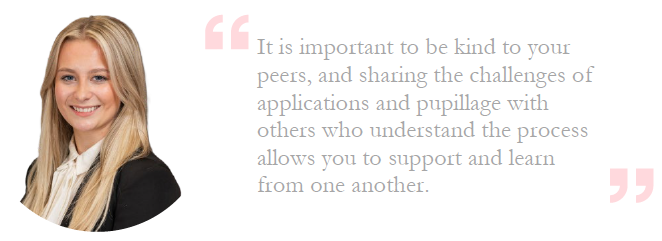
Before completing the Bar Course I focused on building my experience and connections at the bar. I sought mini pupillages, attended seminars, and invested time to develop my understanding of life at the bar. As someone who had no lawyers in my family, the experience and the connections I made became invaluable to my learning and development.
I spent a year as a personal injury paralegal which led me to realise that I wished to pursue a career at the personal injury bar. I was fascinated by the medical evidence and deeply valued working with clients. I often liaised with injured clients to help them navigate litigation which arose as a consequence of an accident, often which was no fault of their own. I realised being a barrister in this area has a real impact on individual’s lives and that I had the opportunity to help them.
Alongside my legal experience, I worked in a customer service role. This taught me just as much. Most importantly it strengthened my communication skills and my ability to work collaboratively and independently. This skill is incredibly important when coming to the Bar in any area, but particularly in personal injury. Communica
tion skills are vital in order to explain complex legal terminology and medical concepts to lay clients. Being able to adapt your communication style to have conferences with clients but also having an ability to communicate and work effectively with professional clients and experts. Having the ability to listen and adapt is a valuable skill.
Like many, I didn’t get pupillage first time round. My journey to the independent bar required resilience and determination. While undergoing multiple pupillage rounds can be challenging, they provide opportunity. These years are an opportunity to refine skills and develop further experience which will ultimately assist you at the bar. The connections I had built offered a source of guidance and encouragement, helping me to identify how to improve and move forward in my career.
I was fortunate to be offered the role of legal assistant to Gerard McDermott KC. Working alongside him provided insight into life as a barrister at the independent bar. I saw firsthand how cases were prepared, how a barrister’s diary is managed and how strategic decisions are made in litigation. I developed practical skills including time management, legal research and organisation, but more importantly, I witnessed the life-changing importance of personal injury law to Claimants. I was a part of a team who acted on behalf of Claimant’s who suffered catastrophic injuries, and as barristers we play a part in helping to improve a Claimant’s quality of life.
Throughout this journey, I have learned that building connections is vital, not only with those already in practice, but with your peers also. The individuals you meet on the Bar Course, during mini pupillages, or at work placements may one day be your colleagues, your opponents, or your closest professional allies. It is important to be kind to your peers, and sharing the challenges of applications and pupillage with others who understand the process allows you to support and learn from one another.
Every role, rejection, connection, and lesson has shaped me into a more resilient, capable, and committed pupil barrister. The journey to the independent bar demands perseverance, adaptability, and belief in yourself. But for those willing to embrace the challenge, it offers the opportunity to make a tangible difference in people’s lives, and there is nothing more inspiring than that.
My advice is to be resilient, use every opportunity to develop your knowledge, and be yourself.

I did not grow up certain that I would come to the Bar. I disliked essay-based subjects at school and the idea of a career that required quite so much reading was daunting. But I loved learning, particularly the feeling of grappling with something unfamiliar and mastering it. During my first mini-pupillage at 17 I shadowed a female criminal barrister who expressed how nice it was to ‘finally’ have a female mini-pupil, as women were still so underrepresented at the independent Bar. From that point on I was determined to pursue a career as a barrister.
I was told, more than once, that the Bar was highly competitive, especially for women. That might have deterred me, but I was extremely fortunate to have some excellent role models. Firstly, my mum, the first female partner and now head of her GP surgery. Secondly, my godmother, a formidable criminal barrister who took silk in 2024. Both had overcome adversity to excel in their respective fields, showing me that if I wanted to, I could too.
I went on to read Law with Hispanic Law at Leeds University and achieved a first-class degree, including a year studying in Spain. That year was demanding both academically and personally, but it taught me that I had enough resilience and determination to succeed. Rejection came too; I was not awarded an Inn of Court Scholarship, but that did not stop me. I made my first round of pupillage applications during the Bar Course, attending interviews alongside a relentless run of exams.
I am unashamed to say that I cried after receiving my offer. I could not comprehend that, on the first time of trying, I had been chosen for a specialist Business, Property and Housing pupillage, a practice area which historically has the lowest female representation. At 23 years old I am now a pupil barrister, about to enter the terrifying world of second six. Believing I could do it and surrounding myself with people who believed I could too made all the difference.
This site uses cookies that enable us to make improvements, provide relevant content, and for analytics purposes. For more details, see our Cookie Policy. By clicking Accept, you consent to our use of cookies.